Skip to content Donate

Publications

Trust, the intangible driving force that keeps institutions alive

Trust, the intangible driving force that keeps institutions alive

In this chapter, part of a collaborative book, it is proposed that the communications department of institutions promote trust as a key element of internal and external relations. Trust is an attitude that is based largely on both facts and perceptions, which is why communication is essential. Some specific suggestions are proposed to overcome division and promote collaboration.

Chapter Publication
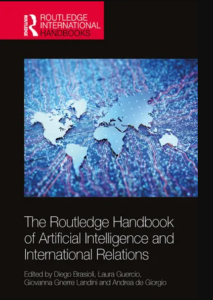
The Routledge Handbook of Artificial Intelligence and International Relations

The Routledge Handbook of Artificial Intelligence and International Relations

The Routledge Handbook of Artificial Intelligence and International Relations examines how machines, algorithms, and data are reshaping the way nations interact, negotiate, and navigate global politics. In the 21st century, artificial intelligence (AI) has transformed from a theoretical wonder to a real force, and with it the race to dominate new technologies is proving to be a key geopolitical concern. This book looks at both the ways in which AI is transforming the landscape of international relations and the challenges this brings.

1st Edition, Edited by Diego Brasioli, Laura Guercio, Giovanna Gnerre Landini, Andrea de Giorgio
Moral und Vertrauen

Moral und Vertrauen

The article deals with the relationship between trust and morality from an ethical and moral-psychology perspective.

Social Trust and the Ethics of Our Institutions

Social Trust and the Ethics of Our Institutions

Social trust is the basic resource for our institutions and is notably maintained by leaders who have what I call a vulnerable style and a vigilant capacity to recognize ethical challenges on the horizon. The essay follows five steps: a meditation on social trust, an introduction to the notion of style, and a proposal for a vulnerable style so as to become collectively capacious for recognition. Then it turns to the two institutions under examination at the 2022 annual meeting of the Society of Christian Ethics (SCE): the church and the academy. 

Inspiring Trust

Inspiring Trust

Cultural and social changes, together with scandals and the incoherence of some groups, led citizens to evaluate organisations more rigorously than ever before. Since then, a culture of suspicion towards political parties, financial institutions, trade unions, the media and also – of course – the Church, has been the norm. This book contains a collection of articles by a variety of authors on a central theme: trust. As a background, the current distrust of the Catholic Church is addressed in many cases.

Church Communications and Organizational Vulnerability
Ethics of Care

Ethics of Care

When we want to provide good care, we often take the will of care users as our starting point. However, how do we do this for vulnerable people who are highly dependent on care? This book offers a practical and theory-based method for ethical deliberation. It encourages care providers to engage in ethical empowerment, making their own ethically responsible decisions based on values, virtues and dialogue. This method is applied to important social developments that care providers are challenging today: from evolutions around networks and confidentiality, decision-making capacity and informed consent, assertive care and restriction of freedom, to euthanasia. The foundation of this method is a relational care ethics, linking everyone who participates in care with the other parties involved. This relationship forms the link between the care user, the next of kin and the care providers. Good care starts from the connection between people. This book will appeal to all professionals in the various care sectors, as well as teachers and students the ethics of care.

Values, Virtues and Dialogue
Second Acts and Second Chances

Second Acts and Second Chances

Throughout history, there are numerous examples of business and government leaders who have fallen from grace only to rise again, and have a “second act” and a “second chance” as a legitimate social actor or leader—that is, they achieved redemption. We explore “the road to redemption” of leaders—when and why it occurs, and what “bumps” prevent it. In our analysis, we conceptualize redemption as a process with three elements—remorse, rehabilitation, and restoration—and as an outcome (the restoration of legitimacy). We argue that achieving redemption is not a product of chance; rather, it is a social construction process of narrative creation and identity construction involving many parties. Also, the road to redemption is shaped by cultural-specific factors—and it is temporally dependent. From this framework, we identify new directions for the theory and practice of leadership.

The Bumpy Road to Redemption

Subscribe to our newsletter

We are delighted to invite you to discover the activities and latest news of Trust & Society through our LSRS newsletter. Don’t miss out — subscribe now!
Newsletter image